

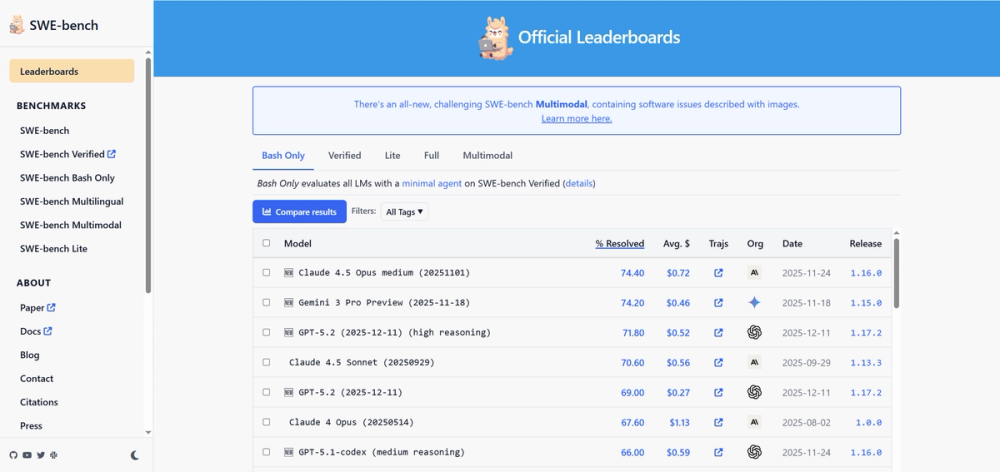
[SWEBench]: The "Truth Serum" for AI Coding Tools
You’ve probably seen a dozen AI coding assistants launch this year, each claiming to be the "fastest" or "smartest" engineer in a box. SWEBench isn't another one of those bots—it is the brutal exam they all have to pass.
Think of it as the Consumer Reports for AI programmers. Instead of trusting marketing hype, you check the SWEBench leaderboard to see which AI can actually fix real-world bugs without burning down your codebase. The best part? The data is 100% free to access, saving you from subscribing to a "pro" coding tool that can’t actually code.
📝 What It Actually Does
SWEBench (Software Engineering Benchmark) takes a different approach to testing AI. Instead of giving bots simple "LeetCode" puzzles (like "reverse this list"), it throws them into the deep end of real GitHub repositories.
-
Real-World "Scrapes": It pulls actual bugs and issues from popular open-source Python projects (like Django or scikit-learn).
- Benefit: It tests if the AI can navigate a massive, messy codebase it hasn't seen before, just like a human hire.
-
The "Verified" Standard: It uses a curated list of 500 hand-verified issues (SWE-bench Verified).
- Benefit: You get a reliability score that filters out bad test cases, so you know a 50% score actually means the bot solved 50% of real problems.
-
Agentic Evaluation: It allows the AI to run commands, create files, and test its own code before submitting.
- Benefit: This measures how well an AI can "act" as an autonomous employee, not just a text generator.
The Real Cost (Public vs. DIY)
Here is the trick: SWEBench is an open-source standard, not a SaaS product. You don't pay a subscription to use it, but using its data saves you money. If you are a developer wanting to run the benchmark yourself on a new model, you pay for the API tokens (computing power).
| Plan | Cost | Key Limits/Perks |
|---|---|---|
| Viewer | $0 | Full access to the Live Leaderboard. See exact pass rates for GPT-5.2, Claude Opus 4.5, and Gemini 3. |
| Runner | ~$0.50 - $2.00 | The estimated API cost per issue to test a model like GPT-5 or Claude 4.5 yourself. |
The Catch: There is no "catch" for the average user viewing the data. For developers running the test, the catch is compute time. A full run on the "Verified" set (500 issues) can cost $250–$1,000 in API credits depending on the model you are testing.
How It Stacks Up
Most benchmarks are easy to game. SWEBench remains the "gold standard" because it is incredibly hard.
- vs. HumanEval: This was the 2023 standard. It asks simple, one-function questions (e.g., "write a Fibonacci sequence"). Most modern AIs ace this (95%+), making it useless for distinguishing top-tier models. SWEBench is much harder, with top models only hitting ~75-80%.
- vs. LiveCodeBench: This competitor refreshes its questions daily to prevent AIs from "memorizing" answers. It’s better for checking if a model is up-to-date, but SWEBench is better for testing deep, complex logic in large files.
- vs. MBPP: Another basic Python benchmark. Like HumanEval, it’s too simple for the AI giants of late 2025. SWEBench remains the only one that simulates a "day in the life" of a software engineer.
The Verdict
We are done with the era of blindly trusting AI demos. In late 2025, if a coding tool doesn't boast its SWEBench Verified score, you should be suspicious.
This benchmark has forced companies like OpenAI, Anthropic, and Google to stop optimizing for chatty conversation and start optimizing for results. It’s not a tool you install, but it’s the most important bookmark in your browser. Before you spend $30/month on the next "AI Engineer," check the leaderboard. If it can't survive SWEBench, it doesn't deserve your credit card.

