

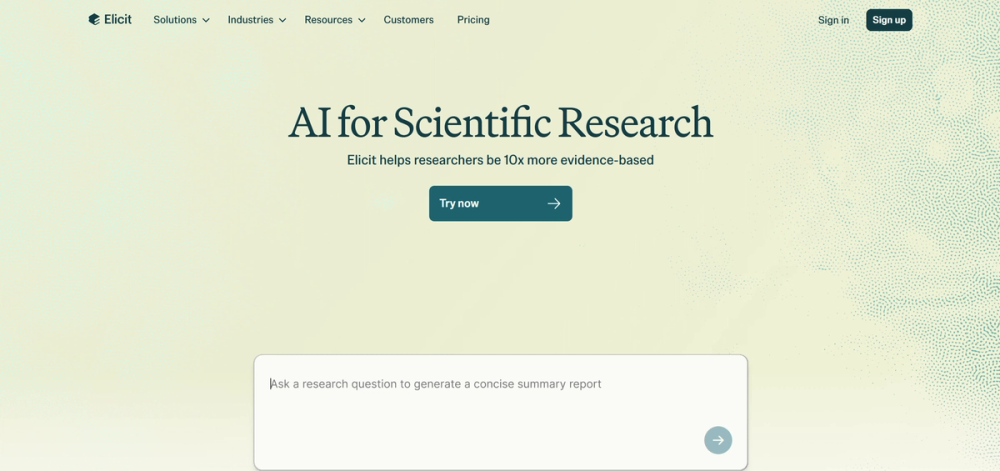
Elicit: The Free AI Researcher That Actually Reads for You
Elicit isn’t just another chatbot—it’s a research assistant that automates the most painful part of learning: opening 50 tabs and trying to figure out which academic papers are actually relevant. Instead of giving you a list of links, it reads the papers for you and organizes the findings into a neat spreadsheet, all on a generous free tier.
🎨 What It Actually Does
- The Matrix View: You ask a question (e.g., "Does creatine improve memory?"), and it doesn't just search—it builds a table. Rows are papers; columns are specific answers extracted from those papers (e.g., "Dosage," "Participant count," "Effect size").
- Semantic Search: It finds papers based on concepts, not just keyword matches. You can search for "methods to reduce concrete carbon footprint" and it will find papers that discuss "cement additives" even if they never use your exact words.
- Abstract Summaries: It rewrites dense academic abstracts into one plain-English sentence, saving you from decoding scientific jargon just to see if a paper is useful.
The Real Cost (Free vs. Paid)
The biggest win for 2025 is that Elicit moved away from a "credit" system for search. You can now search as much as you want for free, but you hit walls when you try to analyze massive batches of documents or get your data out of the tool.
| Plan | Cost | Key Limits/Perks |
|---|---|---|
| Basic | $0 | Unlimited search; Summarize top 4 papers at once; No export (CSV/BibTeX); Upload/Analyze 20 private PDFs/mo. |
| Plus | $12/mo | Summarize top 8 papers at once; Unlimited exports; High-accuracy mode; Upload/Analyze more PDFs. |
How It Stacks Up
- Consensus: The "Google" to Elicit's "Excel." Consensus is faster if you just want a quick "Yes/No" answer (it has a nifty "Consensus Meter" that visually shows if scientists agree). Use Consensus for quick fact-checking; use Elicit for deep dives.
- Scite: The truth-checker. Scite specializes in "Smart Citations"—telling you if a paper has been supported or refuted by other scientists. It’s better for verifying credibility, while Elicit is better for extracting data.
The Verdict
Elicit represents a shift from "search" to "synthesis." In a world drowning in information, the most valuable tool isn't one that finds more content, but one that compresses it into usable truth. It allows an average internet user to perform a level of literature review that used to take a grad student weeks, in about thirty seconds. Even if you never pay a dime, keeping this in your bookmark bar makes you smarter, faster.


